• , , , , ,

Penang Travel Guide

Today I'm taking you to lush Penang, just off the west coast of Malaysia. Penang is one of my favourite places in the world. It's where my grandfather was born, and childhood holidays spent here mean that this island lingers in some of my most treasured memories: riding a horse with my sister along a glittering beach, peering curiously into the cabinets at the Blue Mansion, watching red ants making their inexorable march across the threshold at my great-grandparents' house. Just after Christmas, I returned for the first time in 14 years and made some new memories. Here they are, with an accompanying travel guide that I hope might come in handy for anyone wishing to make a trip to this stunning island.

WHERE TO STAY
We stayed at Shangri-La Rasa Sayang Resort on Batu Ferringhi in the north part of the island. A short flight from Kuala Lumpur followed by a long taxi ride from the airport meant that we arrived at the hotel exhausted and very glad of the cool towels and glasses of icy nutmeg juice provided at reception. Rasa Sayang has the best of both worlds: there's a family area with several pools, table tennis and darts, but also a private pool section (strictly no children allowed) and spa for guests seeking peace and relaxation. It's not quite as fancy as some of the hotels we've stayed in in Malaysia (Four Seasons Langkawi, you'll always be my number one!) but we enjoyed a wonderful stay here. Buffet breakfasts were, of course, bountiful - with everything from roti canai to your choice of noodles, eggs whipped up on request, an abundance of exotic fruits and pastries and dim sum. But even better than the choice is the opportunity to eat breakfast in the shade of the gigantic gnarled raintrees. Rasa Sayang looks out on to Batu Ferringhi, a long stretch of golden sand where you can rent waterskis or just lounge in the sun, as I did, with my law books (woe) and complimentary rosewater ice lollies passed out by the hotel staff. Also on offer is an excellent gym, golf course and tennis courts and a cocktail bar with live music. 


Just watch out for the monitor lizards.

And the jellyfish. (Although I didn't see any while I was on the beach!)

WHAT TO EAT AND DRINK
Cendol, cendol, cendol! If you've read my Kuala Lumpur post you'll know that I'm obsessed with this stuff: shaved ice topped with syrupy gula melaka, pandan rice flour jelly, coconut milk and red beans. Oh man, it's the best. It's also wonderfully flexible: you can either sip it as a drink or have it as a pudding, or both. And in George Town, on opposing sides of the little alley of Jalan Penang, a micro-war rages daily between two stalls. Rather confusingly, they have extremely similar names - Penang Road Famous Teochew Chendul, with blue bowls, and Penang Road Famous Chendol, with orange bowls. Jeez. Let's just call them blue bowls versus orange bowls. The blue bowl stall had by far the bigger queue, so being the docile sheep I am I joined the queue. Fortunately, blue bowl cendol was delicious - and even more exciting is watching the uncle whisking the ice and toppings into the plastic bowls in a matter of seconds. Next time I'll have to do a fair test and try both bowls at once - in the name of research, of course.

Next up: Gurney Drive, also in George Town. This street food market on the seafront is an excellent spot for dinner. Forget the modern food markets you've been to in the past - Gurney Drive is the original and the best. It's noisy, sprawling and not refined in the slightest - be prepared to jostle for a plastic seat. I was a little overwhelmed by the hordes and infinite options, but eventually went for the classics. Smoky char kway teow on a banana leaf topped with plump king prawns with a refreshing glass of sugarcane juice on the side: heaven. A few other excellent dishes to grace the table were oyster omelettes, sweet silken tau foo fa and crisp rojak. You can't really go wrong here. 

While you're in George Town, I recommend a visit to the Eastern & Oriental Hotel. Founded in the 19th century by the same brothers who opened the Raffles Hotel in Singapore, this building is a prime example of colonial architecture and while it's definitely seen better days, it's worth visiting for afternoon tea in the beautiful old cafe or dinner on the terrace. It feels very old world, with languidly rotating ceiling fans, cannons on the waterfront and signs asking guests not to take durian up to their room (a rational request, in my opinion). Here, you'll be able to get a good drink and try a more refined take on Malaysian classics - I had the prettiest Hainanese chicken of my life - and although it's not the most authentic food it's tasty enough and more importantly, the surroundings are beautiful. 

Finally, if you're in Batu Ferringhi looking for dinner, I suggest you try the local night market - it's full of tat (Doraemon electric fans and fake watches puncturing my childhood memories of sweet shell bracelets and wooden toys!) but the street food court remains pretty solid. 

WHAT TO DO
Take a walk around George Town. It's a colourful, fascinating place with a gorgeous UNESCO World Heritage old town, where vibrant street art dances across the facades of the old shop houses. Plus I'd recommend a wander through the streets of bustling Little India, where shops blast Bollywood music at top volume with speakers on the street.

Get to know Peranakan culture. The Peranakan or Straits Chinese, also known as Baba-Nyonya, are the descendants of the Chinese who first came to Malaysia in the 15th century. You can learn about them by visiting the Peranakan houses in George Town, the most famous of which is Cheong Fatt Tze's Mansion, also known as the Blue Mansion for its arresting indigo facade. It's definitely worth a visit (and you can also stay there). On this trip, however, we visited the newly restored Peranakan Mansion, which boasts a pale green exterior and lavishly gilded interior. This is a paradise for lovers of the ornate and sparkly: the mansion is filled with highly photogenic tiles, intricate embroidery and elaborately crafted Nyonya jewels, including gorgeous diamond skin necklaces and a special pair of blue earrings which owe their colour to the painstaking affixing of kingfisher feathers. This is a house in which you can let your imagination run riot: the mansion is decorated as though its wealthy occupants have just stepped out of the room, with bridal gowns laid out carefully on the beds and perfume bottles on the dressing tables, and you'll have to take off your shoes to explore the top levels, just as if you were a real guest of the house. In addition, a fascinating reconstruction of an old shop house and a temple to the ancestors annexed to the main house are well worth checking out. The Mansion is so beautiful and well preserved that you might even witness a Chinese couple having their engagement photos taken, as we did! Please go and thank me later. 

Chill out on the beach. Batu Ferringhi is my favourite and fortunately it was just on our doorstep, but it's also open to the public and is an easy taxi ride from George Town. I've also heard good things about Monkey Beach, Bakar Kapor and Gertak Sanggul, though I believe they're less accessible than Batu Ferringhi. Wherever you are on the island, make sure you take time to relax on the sand and drink in one of Penang's magnificent sunsets. 

Writing these Malaysia posts have made me feel a strange sense of displacement and homesickness. Not fernweh exactly (homesickness for a place you've never been) but more a longing for a place that is home to me, and yet not home. I know I will never tire of trips to this unique archipelago - and I hope that my posts provide some inspiration for people thinking of making trips there too. Terima kasih dan jumpa lagi! 

For more on Malaysia, check out my post on Kuala Lumpur.

Hungry for more? Continue the adventure on Bloglovin' | Twitter | Instagram!

• , , ,

Kuala Lumpur Photo Diary

So, I have some big news - this week, B and I moved in together! Slowly but surely, we have begun the process of creating a home, unfurling our lives from infinite boxes and suitcases into our little flat, perched on the edge of the City. It's been a funny few days - I've been wandering around in a permanent happy daze, buying the most mundane items, like dish racks and bath mats. A lengthy to-do list is steadily being conquered; one box triumphantly ticked was moving files from my laptop to my hard drive. In doing so, I rediscovered hundreds of photos from Kuala Lumpur as well as Penang from my last trip over Christmas and New Year: time really does fly.

Then I wanted to write, because Kuala Lumpur ('KL') is like a second home to me. This sticky, bustling capital city in southwest Malaysia is plagued by thunderstorms and heavy rain, but blessed with some of the best food in the world. My mum was born in the satellite town of Petaling Jaya, just outside KL, and most of my family still lives there. It is a place that will always be dear to my heart. Here are a few pictures and memories from my short time there.

Fighting off jetlag with a swim at the local outdoor pool in the cool early morning, quickly followed by a hearty breakfast of pillowy roti canai with yellow dhal and spicy kari ayam served on a tin tray , accompanied by an iced Milo. Roti canai is only available at the local mamak, where you can also buy pyramids of rice wrapped in sweet-smelling banana leaf. There's Roti King to assuage my cravings when back in London, but it stings when the roti in Malaysia is priced at 20p per plate... Navigating our way back to the house across crumbling pavements, we spot this gargantuan black fly, looking like it's buzzed straight out of Jurassic Park. I want to scream, but am also fascinated by the black body, gigantic and gleaming.

My grandparents' house in PJ, where I take a seat at the long glass table in the dining room, soundtracked by the familiar buzz of the air conditioning unit and the Chinese dramas on the TV in the background. This table has been the site of a hundred meals from a fantastic takeaway restaurant which I know only as 'Fatty's': it's become somewhat of a tradition for our trips to be bookended by Fatty's plastic bags of soupy wat tan hor, sticky, smoky char kway teow and slippery black noodles. In the kitchen I attempt conversations in broken English with Ah Mah, my grandmother. Usually these revolve around the subject of why I haven't secured a Chinese boyfriend yet, although sometimes she takes my hand and presses it between hers, papery and warm, and tells me that she's proud of me. Once I compliment her on her ring, coconut wood with a thin strip of gold, and she immediately insists that I keep it. On Christmas morning I sit in the suspended rattan swing chair on the porch, looking out on to the garden, where bougainvillea cascades down the walls and tropical birds emit a distinctive ascending two-note melody, so unlike the peeps and trills of the birdsong of home.

Speaking of Christmas Day, it's a world away from Christmas in the UK, consisting of a few presents under a plastic tree plus a steaming Milo sipped in stifling 30ºC heat. We spend the rest of the day with my grandparents at their members' club, a KL institution that truly feels like travelling back in time. Founded in the 1980s, the club feels a little like a resort hotel, equipped with bars, restaurants and a gym. However, the design and facilities don't seem to have been updated since the 1980s (which of course suits my grandparents just fine) and the place, sadly past its best, is practically deserted, which we discover as we stroll around giant echoing squash and netball courts. It's reminiscent of visiting the Overlook Hotel - if The Shining were set in Malaysia.

And as usual, food figures most prominently in my memories. On day one and throughout our trip we return time and time again to a beloved hawker centre in State Town which has been going strong for decades. Here, we order bright red watermelon juice, thick toast with kaya (coconut jam) and butter, chicken rice, char siu noodles, crunchy rojak and my favourite drink, cendol. Hawker centres are the best. You'll be able to get the same sorts of dishes from shopping centres, though generally they're much more expensive and nowhere near as good. However, if you do venture mallwards I recommend the cendol from Little Penang Kafe at Mid Valley Megamall, sweet and salty with a generous helping of red beans. Also, don't miss the dumplings from Din Tai Fung (also available at Megamall), expertly rolled out and assembled before your eyes. I await their London debut impatiently.

Hope you enjoyed these snapshots of my Kuala Lumpur trip! Next time I'll be writing about the beautiful island of Penang, home to colourful Nyonya mansions, amazing street food and golden beaches that play host to fiery sunsets.

Hungry for more? Continue the adventure on Bloglovin' | Twitter | Instagram!

• , , , ,

How To Eat In Hamburg

My Hamburg trip woke me up to the joys of German food. My previous Berlin trips had left me with the impression that German cuisine was all wurst and bier. Well, I was wrong. Okay, so I'd be remiss if I omitted to mention sausages and beer entirely, but this great city has so much more to offer. Best of all, it's brilliant for those travelling on a budget, with most meals for two clocking in at under €20. Here's a list of the food (and drink) I think you should try if you're planning a trip!

Fischbrötchen at Brücke 10 (St Pauli-Landungsbrücken 10)
Brücke 10, a little shack on the riverfront, offers the typical Hamburg dish. And no, it's not a hamburger; it's fischbrötchen, a fresh fish roll served with raw onions or pickles. (It's lucky that B and I have been dating for a while, isn't it?) Stick with me here - it's actually delicious. We tried two iterations of this traditional sandwich: herring and kräutermatjes (€3-3.50 each). This humble dish surprised me - it's full of complex flavours and textures. The fish, creamy yet meaty, offers notes of nutmeg and lemon, and is incredibly refreshing, especially when washed down with Alsterwasser, a Hamburg shandy. These are served cold and therefore probably best eaten al fresco at the height of summer, watching the huge liners sailing past. However, in the winter there's also the option of taking shelter inside the cute shack and snuggling up with sheepskin rugs while you chow down, and there's also warm food like Fischfrikadelle (fish balls).

Wurst at...

Mö Grill (Lilienstraße 36)
Simply the best: mildly spiced Currywurst with thickly-cut Pommes and a huge dollop of mayo. Cheap and filling. There's lots of 'Kombis' on offer at this particular joint: essentially meal deals where you can get currywurst, chips and a drink for about €5. Nicht schlecht!

Isemarkt
For an even simpler lunch, have a little tray of classic Bratwurst and chips for lunch under the rails of the Isemarkt. We ate incredibly well at the Isemarkt (read more about this brilliant market in my 10 Things To Do In Hamburg post) - there's tons of choice, and if you're not keen on meat there's also the veggie option below...

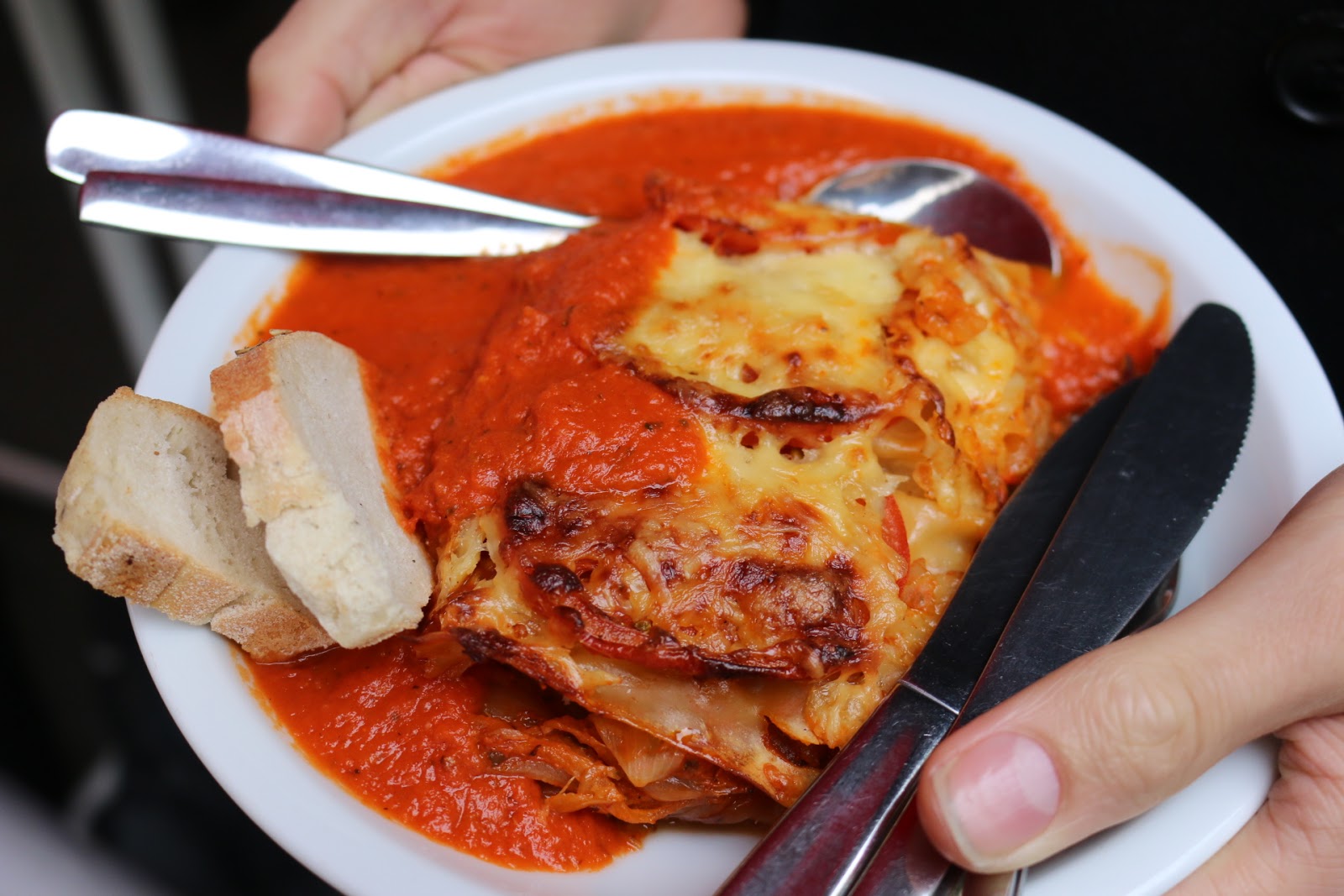
Vegetarian lasagne at Isemarkt.
Like most German food, this lasagne is hearty and you get lots for your money (€5, or €4.50 without the sauce) - but is lighter without the meat. I'm not sure what this stall was called - perhaps 'Vegetarische Spezialitäten' - but I'd recommend walking along the Isemarkt to find it for lunch. As you might have guessed, it specialises in vegetarian food, from spelt pasta salad to Auflauf, and also does a fantastic range of juices, We had one with carrot, beetroot and celery, which tasted delicious and felt very cleansing. Which was sorely needed after all that fried food. 

Flammkuchen at Jimmy Elsass (Schäferstraße 26)
The speciality at this cool restaurant is a crispy, creamy quasi-pizza. Please don't attack me, Italians and Germans - the two are wildly different. There's a base covered with a range of toppings, and there the similarity ends. The shape is different - Flammkuchen are more oval or rectangular, and much thinner. We had goat's cheese with pear and Schwarzwald ham with rosemary and mushrooms. You can also enjoy über-Deutsch specialties here, such as steins of fantastic beer and Obatzter: a fluffy pretzel with a cheesy dip, cornichons and peppery radishes. The flammkuchen are pretty affordable, roughly comparable to London pizza prices at €8.50-11.50. 

 Pfannkuchen in the Kleinhuis' Cafe & Weinstube (Peterstraße 28)
In my experience, Hamburg museums have fantastic cafes, so you won't go hungry if you're in search of culture! Wiped after visiting the Komponisten-Quartier Museum, we sat down for a bite to eat in the elegant adjoining bistro-cum-cafe, which is not cheap but offers some great lunch options such as these pfannkuchen: mini crêpes topped with pulled pork (for me) and a feta and tomato salad (for him).

  Kaffee und Kuchen at...

Cafe Gnosa (Lange Reihe 93)
Gnosa is an amazing old-school establishment where you can peruse a cabinet stuffed full of cake and sip your coffee while leafing through the newspapers on poles. We chose a rhubarb streusel which came with tons of cream. Drinks: coffee for B and a hot chocolate for me. 'Would you like cream with that?' asked the waitress innocently. I answered in the affirmative, and along with a brimming cup of hot chocolate and biscuit came an espresso cup FULL of cream. On top of the cloud of cream that came with the cake. The Germans know how to live.

Kaffeerösterei (Kehrwieder 5)
This warehouse in the Speicherstadt is actually a coffee museum, so obviously it's got a great café. We walked in here exhausted after a day of roaming around the city and flopped down next to the antique roasting machines, but were soon revived after a predictably great freshly roasted coffee, a plump Pflaumenkuchen (plum cake) and thick, sweet hot Kakao, both garnished with the requisite mountain of cream.

Kunsthalle (Glockengießerwall)
I intend to write more fully about the Kunsthalle in due course, but for now let it be said that this brilliant art museum has great cake to match. B is crazy for Mohn (poppy seed) and this earthy Mohnkuche lived up to expectations. It went particularly well with a floral, full-bodied Earl Grey. I seem to recall that this was the most expensive of the cafes we visited, with a deal pricing a big cup of coffee and slice of cake for €5. However, be warned - if you want your peak of whipped cream with the cake you'll have to pay extra for it! Which I did, because I'm an addict.

Wine at Alles Elbe (Hein-Hoyer-Straße 63)
This amazing underground bar is a stone's throw from the Reeperbahn. It's an intimate space illuminated by candlelight, specialising in wines created along the banks of the river Elbe. I enjoyed a very good Riesling here: light and floral with a crisp green flavour, reminiscent of freshly sliced cantaloupe melon. B chose an Apfelwein which tasted citrusy yet reminded me of tarte aux pommes - incredibly light with an intense apple flavour. It's a charming bar, serving little pots of pretzels with the drinks, the tables adorned with little bottles of tulips and baby's breath, a record player in the corner piping unobtrusive jazz and signs on the wall forbidding political chat. It's also pretty cheap - I paid €3.60 for my glass of wine. I just know that if we lived in Hamburg that this would be a regular haunt, and wish I could find an equivalent in east London. 

I hope that this post (as bloated as my belly after my visit...) proves that Hamburg is rich in food offerings! I haven't even written about Hamburg's burgeoning bakery scene. As in Germany generally, there's a bakery on every corner - sometimes two or three - and breakfast is guaranteed to be exciting, with delicacies such as Mohnschnecke or Franzbrötchen to sink your teeth into. Try both!

If you want to read more on Hamburg, check out my 10 Things To Do In Hamburg post. 

Hungry for more? Continue the adventure on Bloglovin' | Twitter | Instagram!